
If your clinic is still collecting session data on paper, or you find yourself jumping between disconnected tools to manage treatment plans, session notes, and graphs, you’re probably frustrated.
Data gets lost.
Graphs take too long to build.
And BCBAs are stuck spending their time on paperwork instead of with clients.
ABA data collection software should do more than replace the paper data sheet. The right platform will connect your entire clinical workflow. So you can see everything in one place:
In this article, we’ll show you what manual or disconnected data collection is quietly costing your clinic. Then, we’ll walk you through what to look for in the right data collection software for your ABA clinic.
It’s true that manual systems look inexpensive. After all, paper’s cheap, and spreadsheets are free.
But the real cost isn’t so obvious: time.
Think about how many hours your BCBAs spend each week transcribing data, building graphs by hand, or tracking down session information that should be right in front of them.
A technician spending 30 minutes per client on data entry loses roughly 25 hours a month to admin work. That’s time that should go toward direct care.
Then there’s the clinical risk. Manual data entry can lead to errors. Plus, inconsistent recording across staff members means your BCBA might be making treatment decisions based on incomplete or inaccurate information.
And disconnected tools make running a clinic even harder. When your treatment plans, session notes, and graphs live in three different places, you can’t see clearly what’s actually happening in your clinic.
Goals stall.
Problems go unnoticed.
And compliance risk builds quietly in the background.
When you’re evaluating ABA therapy data collection software, the question to ask isn’t just about what features it has. The better question is, “Does it connect my entire clinical workflow, or does it just digitize the paper?”
Here’s what you should expect from a strong platform:
Data collection in your ABA clinic starts before the session. A good platform will offer built-in clinical assessment tools and connect them directly to your treatment plan builder.
With ABA Engine, you can run assessments like Multiple Stimulus Without Replacement (MSWO), Free Operant Preference Assessment, and Cold Probe Skill Assessment right inside the platform. From there, you build out a treatment plan, set goals, and connect everything into the workflow that drives your session data collection.
No manual handoff.
No re-entering data in a second system.
Everything flows forward.
Treatment plan templates help here, too. When your team can start from a template and customize for each client, onboarding new clients gets faster and your documentation stays consistent across your entire clinic.
ABA therapy involves measuring behavior in many ways. Your software needs to support all of them without creating more work for your technicians.
A solid ABA data collection app should handle:
In the ABA Engine platform, each goal is linked to the right data collection widget automatically based on how the goal was set up. Technicians get clear prompts during the session:
Is the behavior happening now?
Did it happen throughout the interval?
How many trials are left?
This way, they don’t have to make judgment calls mid-session about how to record.
Other features that matter in the real-time flow of a session:
Minimum and maximum trial settings with a visual green indicator when minimums are met
One of the biggest advantages of the right ABA clinic software is that supervisors don’t have to wait. While a technician is running a session from the employee app, your BCBA or admin can log in and see live data from the admin view.
Once the clinician finalizes a session, you can pull up any client and see everything in a single glance. This includes which goals were targeted, which employee ran the session, what behavior events occurred, and what the antecedent and consequence were for each one.
You can also filter by date range across all goals.
That kind of visibility means better supervision, better documentation, and fewer surprises during insurance or parent reviews.
Your team should not be building graphs manually.
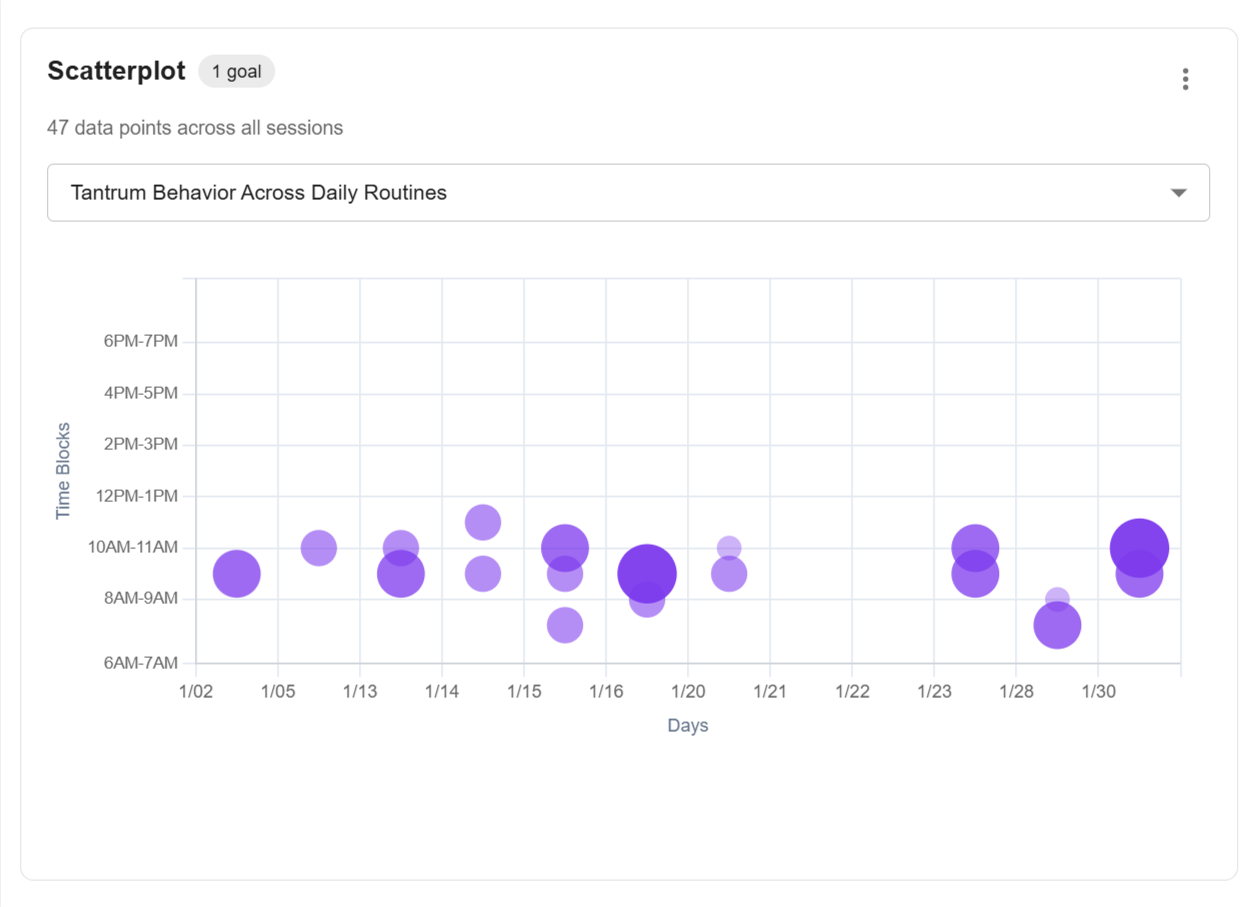
Every data point collected in a session should flow automatically into goal-level graphs your BCBAs can review at any time.
In ABA Engine, you can view graphs per client, filter by goal and date range, and see individual data points alongside average percent correct across sessions. And you can export those graphs as part of reports for parents, funding sources, or insurers.
Automastery is another feature worth looking for. When a client meets their mastery criteria, the system flags it automatically. Your BCBA will get the signal right away instead of discovering it days later during a manual data review.
Clinical documentation doesn’t stop at session data, of course. You need a home for your intake forms, behavior intervention plans, parent interviews, and session notes.
ABA Engine includes a full form builder so your clinic can create custom forms for any clinical or administrative need. And it’s all within the same system where your session data lives.
No more documentation scattered across different tools or file folders.
Your technicians collect the data your BCBAs rely on. And that collection often happens in busy, fast-moving sessions. If the software is hard to use or unclear in how it prompts recording, the quality of your data will suffer.
Good BCBA data collection software is built for your whole clinical team.
Technicians get clear in-session guidance.
Supervisors get clean, organized data they can act on.
Admins get the reporting and visibility they need to run the clinic efficiently.
Our founder, Erica Kinnebrew, designed ABA Engine to meet this exact standard ABA Engine.
Before you commit to a platform, ask these questions:
The answers to these questions will tell you quickly whether a platform will actually change how your clinic operates. Because you don’t want just another tool to manage.
When your treatment plans, session data, ABC events, and progress graphs all live in one connected system, your team spends less time moving information around and more time using it.
BCBAs focus on clinical decisions instead of documentation.
Technicians collect cleaner data with less effort.
Admins have the visibility they need to catch problems early and keep things running smoothly.
That’s how growing ABA clinics stay clinical without getting buried in admin work.
When your treatment plans, session data, ABC events, and progress graphs all live in one connected system, your team spends less time moving information around and more time using it.
BCBAs focus on clinical decisions instead of documentation.
Technicians collect cleaner data with less effort.
Admins have the visibility they need to catch problems early and keep things running smoothly.
That’s how growing ABA clinics stay clinical without getting buried in admin work.
ABA data collection software replaces paper data sheets and disconnected tools with a single platform for capturing, organizing, and reviewing session data. The right platform reduces manual work for your team, improves the accuracy of your data, and gives your BCBAs immediate visibility into client progress. So treatment decisions happen faster and with better information.
ABA Engine supports trial data with prompt levels, frequency, rate, duration, latency, task analysis, interval recording (momentary, whole, and partial), cold probe, rating scales, and ABC event logging. Each goal is linked to the appropriate data collection widget automatically based on how the goal is set up.
Yes. While technicians collect data through the employee app, supervisors and admins can log into the admin view and see live session data at any time. After sessions are finalized, admins can review all session details, goal progress, behavior events, and graphs. All of the data can be filtered by client, goal, or date range.
Yes. Every data point collected in a session feeds automatically into goal-level graphs. You can filter by goal and date range, view individual data points and session averages, and export graphs for parent reports, insurance documentation, or team reviews.
ABA Engine covers the full workflow. You can run clinical assessments, build treatment plans from templates, set up goals, run sessions, monitor progress, and document everything through the built-in form builder, all in one platform. The goal is to eliminate the manual handoffs and disconnected tools that slow clinics down.